Your pipeline is probably lying to you. Most B2B sales teams fill their CRM with contacts who don't have budget, aren't the decision-maker, or are 18 months away from actually buying. Salesforce's State of Sales report found that sales reps spend only 28% of their week on actual selling. The rest goes to admin, prospecting, and chasing leads that were never going to close.
BANT lead qualification AI changes that ratio. Instead of sending a human to run the four-question filter, you deploy an AI voice agent to call every lead on the list, score them against Budget, Authority, Need, and Timeline, and route only the qualified ones to your team. Your reps pick up the phone with context in hand and skip the 60% of calls that should never happen.
Key Takeaways
- BANT (Budget, Authority, Need, Timeline) was developed by IBM in the 1960s and remains the most widely-used B2B qualification framework in sales today, six decades later.
- An AI voice agent completes a full BANT qualification call in under 3 minutes. Topcalls processes 63,000+ such calls daily across its customer deployments.
- Running BANT via AI costs $0.35 per minute all-inclusive, roughly 95% less than the $150-250 per hour an SDR spends running the same calls by hand.
- Leads that pass AI BANT scoring connect 60%+ more often with human reps than unscreened cold contacts do.

- Most teams get their first AI BANT campaign live in about 15 minutes: script, scoring thresholds, and CRM routing all configured.
1. What is BANT Qualification?
BANT stands for Budget, Authority, Need, and Timeline. IBM developed it in the early 1960s as a four-criteria filter for enterprise sales, a way to separate real buyers from contacts who'd never close. Each criterion is binary: the prospect qualifies or they don't. A lead that clears all four is a genuine sales opportunity. A lead that fails two or more goes to a nurture track or off the active list entirely.
Each criterion checks one thing:
- Budget: Does the prospect have money allocated for a solution like yours this fiscal year? Not 'we might get approval', confirmed, real budget that exists right now.
- Authority: Are you talking to the person who can sign a contract, or someone who'll need to run it past their manager? Identifying the economic decision-maker early saves weeks of chasing a champion with no buying power.
- Need: Is there a specific, felt business problem that your product directly solves? And is fixing it a priority now, not in some vague future quarter?
- Timeline: When does the prospect plan to make a decision? A contact who's 'thinking about it for next year' is in a very different pipeline stage than one who needs something live in 60 days.
BANT gets criticized for being blunt. That's exactly what makes it useful at scale. It's not a discovery framework. It's a filter. You're not building a full account map; you're deciding in 90 seconds whether this lead is worth a discovery call.
2. How Do You Automate BANT Scoring by Phone?
You automate BANT by building a qualification campaign in an AI voice platform. The AI places outbound calls, works through a structured script covering all four BANT dimensions, scores each response as the call progresses, and routes results to your CRM automatically. There's no human reviewing calls before routing happens. The lead is in the right pipeline stage within seconds of the call ending. Setup takes about 15 minutes.
Step 1: Write Your Qualification Script
Your script needs four to five questions in a natural conversational order. Start with Need because it's the least threatening and gets the prospect talking before you ask about money or authority. Move to Timeline next, then Authority, then Budget. In Topcalls, you write the script once and the AI handles branching logic: if a prospect says they're not the decision-maker, the agent asks who is and whether that person should be on the next call.
Step 2: Set Your Scoring Thresholds
Define what a qualified lead looks like before the first call goes out. Most teams use four tiers:
- 4 of 4, Sales-ready. Pass to an SDR immediately with the call transcript and a suggested conversation opener.
- 3 of 4, Strong fit. Priority nurture; follow up within 48 hours.
- 2 of 4, Partial fit. Add to a 90-day drip sequence.
- 0-1 of 4, Poor fit. Remove from active pipeline.
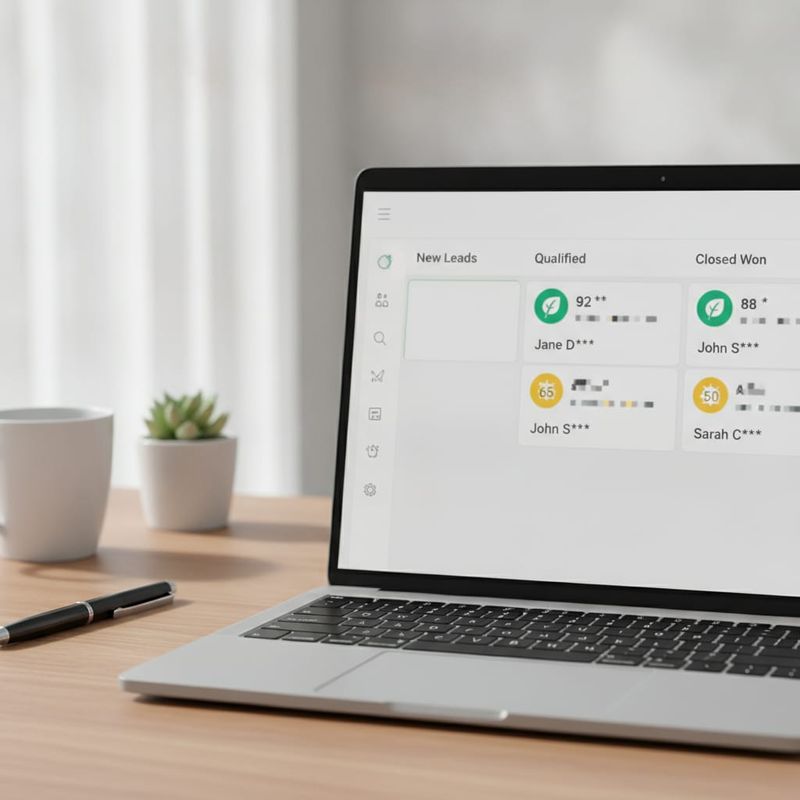
The right thresholds depend on your list quality and deal size. Teams selling high-ACV products often treat 3 of 4 as worth an SDR conversation. Volume outbound teams doing $5-15K deals might only pass 4 of 4 leads to reps.
Step 3: Connect Your CRM
Topcalls connects natively to Salesforce, HubSpot, Pipedrive, and Close, and to 5,000+ other apps via our integrations platform. When the AI finishes a qualification call, the BANT score, transcript summary, and lead status write directly to the CRM within seconds. No manual entry, no handoff delays, no missed follow-ups.
Step 4: Review Transcripts and Optimize
After the first 50-100 calls, read through 10-15 transcripts. Patterns show up fast: a question that confuses people, a branch condition that fires wrong, or a timeline question that cuts the conversation short before you got to budget. Adjust the script and rerun. Most teams dial in their BANT campaigns within the first week.
Want to know what unqualified leads are actually costing your team right now? Run the numbers in our ROI calculator, input your call volume and average deal size and it gives you the real number.
3. What Questions Does an AI Agent Ask to Qualify?
A well-built AI BANT script uses one budget question, one authority check, two to three need questions, and one timeline probe. The phrasing is conversational, not interrogative. The AI adapts based on answers: if the prospect reveals a pain point, it follows up before moving on. Topcalls qualification calls average under 3 minutes. Here's what each BANT dimension sounds like in practice:
- Budget: 'Do you have a specific budget set aside for this type of solution this year, or are you still in the research phase?' If they say yes, the AI asks whether it's been formally approved.
- Authority: 'Are you usually the one who makes the call on tools like this, or does it involve others on your team?' If authority is shared, the agent asks who the main decision-maker is and whether they should be on the next conversation.
- Need: 'What's the main challenge you're trying to solve right now?' then 'How much is that affecting your team day to day?' Two questions that let the prospect describe the problem in their own words.
- Timeline: 'If you found the right solution this week, what does your decision timeline look like?' The hypothetical framing tends to get a more honest answer than 'when do you plan to buy?'
The AI doesn't follow the script in lockstep order. If a prospect mentions a budget constraint unprompted, the agent acknowledges it and adjusts. If they reveal they're a champion but not the economic buyer, it asks to set up a call with the right person. That responsiveness is what separates a good AI qualification call from a survey that sounds like a robot reading a checklist.

This is exactly what our AI lead qualification solution is built to do: run these conversations at scale so your reps walk into handoff calls knowing the prospect's budget status, decision authority, core problem, and buying timeframe before the first word is spoken.
4. How Does Qualified-Lead Routing Work?
When the AI finishes a qualification call, it scores the lead against your predefined BANT thresholds and writes the result to your CRM in real time, within seconds. Leads above the threshold get flagged as sales-ready and trigger an immediate notification to the assigned rep. Leads below the threshold route to a nurture sequence or get removed from active pipeline. No human reviews calls before routing happens.
Your rep sees four things when the handoff arrives: the BANT score, a transcript summary, the prospect's own words from the Need question, and a suggested conversation opener. It's a different experience than calling cold. That context is what drives the 60%+ connect-rate lift Topcalls teams see on qualified follow-up versus unscreened outbound.
If you're evaluating which platform to run BANT campaigns on, our comparison of the best AI cold calling software in 2026 breaks down how platforms differ on routing logic, CRM integrations, and per-minute pricing.
5. Is BANT Still Effective in 2026?
BANT works in 2026, and it works better than ever when the qualification call itself is handled by AI. The four criteria haven't changed: budget, authority, need, and timeline are still the dimensions that determine whether a deal will close. What's changed is that an AI voice agent can now run those calls at scale, so your reps spend time only on leads who've already passed the filter.
For high-volume outbound, BANT is the right choice. It's fast, binary, and built for automation. MEDDIC fits complex enterprise opportunities where a single call can't surface all six criteria and you're navigating a committee buying process over multiple months. CHAMP works when you have strong inbound intent signals and lead with challenges rather than budget. But if you're calling a list of 500 prospects and need to sort them in three days, BANT wins.
HubSpot's B2B marketing research consistently identifies lead qualification as the top pipeline bottleneck for sales teams. The question isn't whether to qualify. It's whether you're doing it at the front end, where it's cheap and automated, or at the back end, where it costs rep hours and kills morale.
Where BANT Doesn't Work
BANT struggles on multi-threaded enterprise deals where qualification requires mapping 8-12 stakeholders across a 3-6 month buying process. If a single 3-minute call can't surface all four dimensions, the framework breaks. Deals above $100K average contract value usually need MEDDIC or a structured multi-touch discovery process to qualify accurately.
It also doesn't land well on lists with zero brand awareness. When a prospect doesn't know who's calling or why, they give defensive answers on budget and authority. BANT works best on warm leads: inbound inquiries, event registrants, or contacts who've engaged with content and have at least some prior context before the call.
If you're running outbound at scale and want to see what an AI BANT qualification campaign looks like for your specific list and ICP, book a strategy call with us. We'll walk through your script, scoring thresholds, and CRM routing in the first 30 minutes.
Frequently Asked Questions
Get AI calling tips in your inbox
No spam. One email per week with actionable sales automation tips.