
A brand-new phone number can get tagged "spam likely" on its first 50 calls. Not because anyone abused it. Because it has no history, no reputation, and no track record the carrier can trust. So the carrier hedges and labels it. To warm up phone numbers means building that reputation on purpose, in a slow ramp, before you ever run them at full volume. Skip the warmup and your answer rate craters before your script gets a word in.
The stakes are real. Robocall complaints to the FTC fell from 3.4 million in 2021 to 1.1 million in 2024 (FTC, 2024), and carriers got that win by labeling aggressively. Legitimate outbound calls now get caught in the same net. This guide walks the 7-step warmup that keeps your numbers clean, with the daily caps and reputation checks that hold the line.
Key Takeaways
- A new number has no call history, which is why it gets mislabeled most often on its first few dials, not because of past misuse.
- Warm up over 2 to 3 weeks: roughly 20 to 30 dials on day one, then ramp 20 to 30 percent every few days toward your cap.
- Cap each number near 200 dials a day; above 200 to 250, carrier algorithms start auto-flagging on volume alone.
- Calls labeled spam likely answer below 10 percent, so one flagged number can sink a whole campaign's contact rate.

- Topcalls runs calls at $0.35 a minute all-inclusive with sub-500ms latency, processing 63,000-plus calls a day across clean number pools.
- Local presence and A-level STIR/SHAKEN attestation both raise answer rates, but neither replaces a slow volume ramp.
How do you warm up a phone number for cold calling?
You warm up a phone number by starting with low daily volume and ramping it over 2 to 3 weeks while building real call history. Begin with 20 to 30 dials on day one, hold short answered conversations, and add 20 to 30 percent more dials every two or three days. The goal is steady, human-looking activity that teaches carrier analytics the number belongs to a legitimate business.
Carriers and their analytics partners score every number on behavior. A number that places 30 calls, gets a few answered, and holds 90-second conversations looks nothing like a number that fires 500 dials in an hour with no pickups. The warmup is you proving, call by call, that you're the first kind.
The 7-step warmup, week by week
- Register the number first. Before the first dial, add it to the Free Caller Registry and your carrier's branded-caller database so it's a known business, not an unknown caller.
- Confirm A-level attestation. Check that your provider signs the number with full STIR/SHAKEN A attestation, which tells receiving carriers the caller is verified and slows down the spam algorithm.
- Start small (week one). Run 20 to 30 dials a day. Aim for a handful of real, answered conversations rather than blasting through a list.
- Ramp gradually (week two). Add 20 to 30 percent more dials every two or three days. A jump from 30 to 300 overnight is the exact spike carriers watch for.
- Keep conversations real. Sub-30-second calls with no pickups read as spam. Longer answered talks raise the number's reputation more than raw volume ever will.
- Hit full volume (week three). Settle the number near its daily cap, roughly 150 to 200 dials, and hold it there. Don't bounce around day to day.
- Monitor weekly, forever. Reputation isn't a one-time setup. Check each number's spam status every week and pull any number that starts showing a flag.
Why does a carrier flag a new number?
A carrier flags a new number because it has no call history to vouch for it. Analytics engines from Hiya, TNS, and First Orion score numbers on call volume, answer rate, call duration, consumer complaints, and STIR/SHAKEN attestation. A fresh number scores blank on most of those, so when it suddenly dials at volume, the safest guess for the carrier is to label it spam likely and protect the subscriber.
The FCC has pushed carriers to deploy free call-blocking and labeling by default, and most have (FCC consumer guide). That default-on labeling is why a clean, well-intentioned business number still gets caught. The system is built to flag first and ask questions later.
What trips the spam algorithm
- Volume spikes: a number that goes from zero to hundreds of dials in a day is the single loudest signal.
- Short durations: lots of sub-30-second calls signal nobody wants to talk, which reads as spam.
- Low answer rate: 500 dials and 50 pickups is a 10 percent answer rate, and the algorithm reads that as people dodging you.
- Consumer complaints: a few "block this number" taps from people you called can flip a number's status overnight.
Running outbound at real scale without torching your numbers takes a system, not a spreadsheet. See how AI voice agents for sales acceleration keep volume high and reputation clean at the same time.
How long does number warmup take?
Number warmup takes about 2 to 3 weeks to reach full daily volume safely. Week one stays low at 20 to 30 dials, week two ramps 20 to 30 percent every few days, and by week three the number holds steady near its 150 to 200 dial cap. Rush it and you compress weeks of trust-building into a spike that gets you flagged anyway.
There's no shortcut that skips the calendar. Reputation is earned through accumulated behavior, and accumulated behavior takes days. The teams that warm up the fastest are the ones running several numbers in parallel, each on its own slow ramp, so total campaign volume climbs even while every individual number stays patient.
A simple 3-week ramp for a single number looks like this:

Does local presence dialing help?
Local presence dialing helps answer rates because people pick up calls from their own area code far more often than unknown long-distance numbers. Matching the caller ID area code to the lead's region is one of the cheapest answer-rate lifts available. But local presence is a complement to warmup, not a replacement. A flagged local number still shows spam likely, so you warm up every number in the pool, local or not.
The trap with local presence is shared number pools. If 40 other businesses dial from the same recycled local number, its reputation is out of your hands and you inherit their flags. Use private, dedicated local numbers you control and warm up yourself, never a shared pool. Reputation you can't see is reputation you can't fix.
Want to see what a higher answer rate is worth to your pipeline? Run the numbers in our ROI calculator and watch how connect rate moves cost per booked meeting.
How do you monitor number reputation?
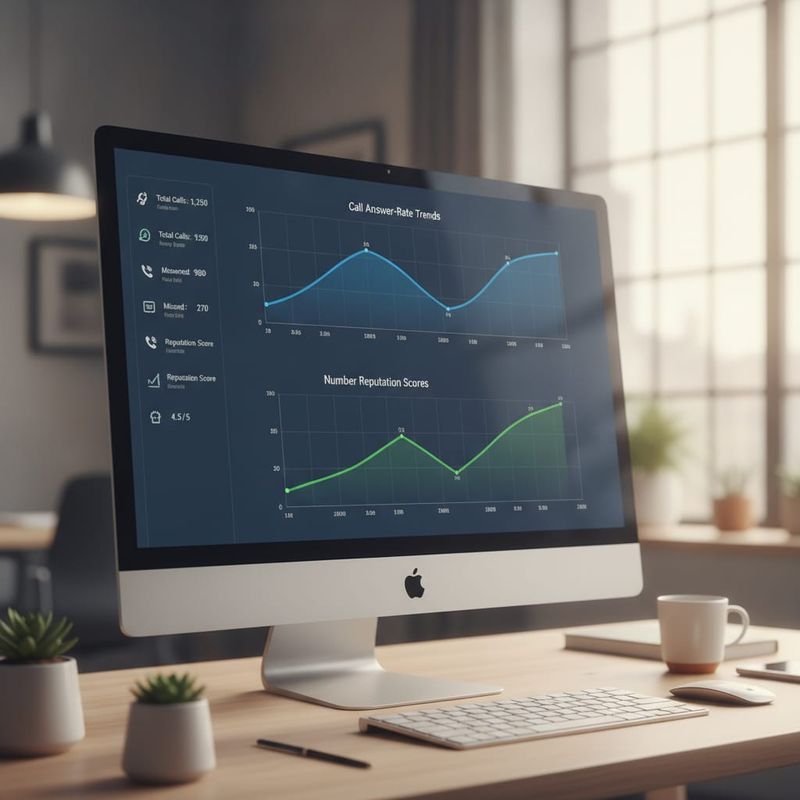
You monitor number reputation by checking each number's spam status weekly against the major analytics engines and watching answer-rate trends. Tools like Caller ID Reputation, NumberGuard, and free carrier lookups show whether a number reads as clean, spam likely, or scam likely on T-Mobile, AT&T, and Verizon. Pair that with your own answer-rate data, because a sudden drop is your earliest warning sign.
When a number does get flagged, rest it. Pull it from the rotation, file a remediation request with the analytics provider that labeled it, and let it cool while a fresh, warmed number takes its place. A number flagged spam likely answers below 10 percent, so leaving a flagged number in service quietly bleeds your contact rate every single day it dials.
The metrics that signal trouble
- Answer-rate drop: a number that fell from 25 percent to single digits is almost certainly flagged.
- Spam-label status: check it across all three major carriers, since one may flag while others stay clean.
- Complaint signals: a tighter list and better targeting cut block-and-report taps, which is what poisons reputation fastest.
Better targeting starts upstream. When AI qualifies leads before a rep dials, you call fewer wrong people, hear fewer complaints, and keep every number's reputation intact for longer.
How does Topcalls keep numbers clean at scale?
Topcalls keeps numbers clean by spreading volume across warmed, registered number pools and running smart retry logic that avoids the back-to-back spikes carriers punish. Processing 63,000-plus calls a day at $0.35 a minute all-inclusive, the platform paces dials, holds A-level attestation, and pulls flagged numbers automatically. The result is a 60-percent-plus average lift in connect rate versus cold-launched, unwarmed numbers.
Sub-500ms response latency keeps conversations long and natural, which itself feeds clean reputation, since real talk time signals a real business. The secure calling infrastructure handles attestation and TCPA, TSR, and GDPR compliance so your team focuses on conversations, not carrier politics. Smart retry spaces busy and unanswered numbers across minutes and hours instead of hammering them.
Warmup is one layer of answer-rate defense. For the attestation side, read our guide on STIR/SHAKEN attestation and stopping spam flags, and to clean up the other end of the funnel, see how to slash your call abandonment rate.
When is warmup not the real problem?
Warmup is not your fix when the underlying list or offer is the problem. If you're dialing stale, mistargeted, or do-not-call numbers, no amount of warming saves you, because the complaints that flag your number come from calling the wrong people. Warmup protects a healthy operation. It can't rescue a campaign that people genuinely don't want to receive.
Fix the list first. Scrub against the National Do Not Call Registry, tighten your targeting, and sharpen the reason you're calling. Then warm the numbers. Do it in that order and the warmup holds, because the people picking up actually want the conversation. Reverse the order and you'll keep burning fresh numbers no matter how slowly you ramp them.
Clean numbers are a discipline, not a one-time setup. If you'd rather skip the manual ramp and run outbound on pre-warmed, monitored number pools from day one, book a strategy call and we'll map it to your volume.
Frequently Asked Questions
Get AI calling tips in your inbox
No spam. One email per week with actionable sales automation tips.