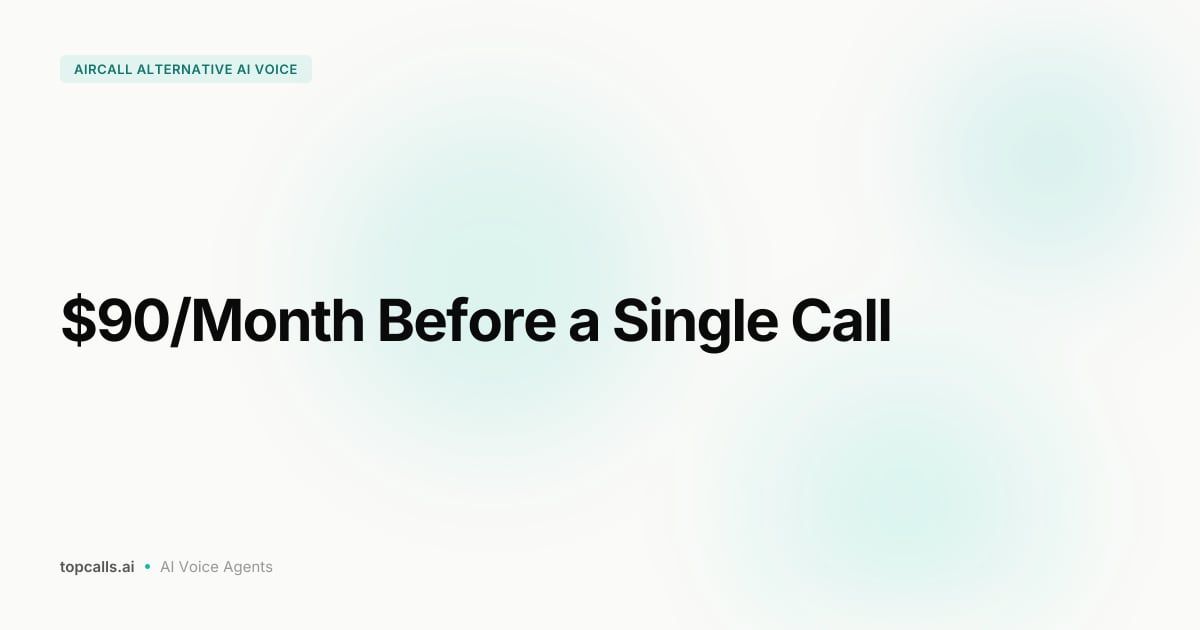
Aircall's cheapest plan costs $30 per user per month, with a minimum of three users. That's $90 before your team makes a single call. Want call summaries or sentiment analysis? Add another $9 per seat. Most Aircall alternative options don't have that pricing structure, and the best ones include AI voice agents that run outbound calls without human involvement.

This comparison covers eight tools replacing Aircall in 2026. Some are traditional cloud dialers that beat Aircall on price or integrations. Others are AI-first platforms where the per-user model doesn't apply. You pay per minute of actual call time instead.
Key Takeaways
- Aircall pricing: its cheapest plan is $30 per user with a 3-user minimum, so a team pays $90 monthly before placing a single call.
- AI is an add-on: Aircall charges $9 per seat for call summaries and sentiment analysis, while these features are not included in any base plan.
- TopCalls pricing: TopCalls charges $0.35 per minute all-inclusive, with no per-seat fees, no AI add-ons, and no minimum user count.
- Scale and speed: TopCalls processes 63,000+ calls daily at sub-500ms latency and supports 29+ languages across 36+ accent variants.
- Setup time: A TopCalls campaign takes about 15 minutes to launch, while developer-first Bland AI starts at $0.09 per minute but needs custom code.
1. Why Teams Are Moving Away From Aircall
Aircall isn't a bad product. It handles inbound routing cleanly, integrates well with most CRMs, and teams can learn it in an afternoon. The problems show up at scale.
The per-seat model means every rep who needs access adds $30 to $50 to the monthly bill, permanently. The AI features sales teams actually want — summaries, coaching, sentiment — aren't included. They're a $9/seat add-on. The power dialer, which is standard on most competing platforms, only comes with Aircall Professional at $50/seat.
- Minimum 3-user requirement: $90 to $150/month before your team dials a single number
- AI features (summaries, sentiment): $9/user/month add-on, not included in any base plan
- Power dialer: Professional plan only at $50/seat/month
- No native AI voice agents: can't run autonomous outbound without a human rep in the loop
- Linear cost scaling: want more call capacity? Hire more reps. There's no AI multiplier built in
2. TopCalls — Best for Autonomous Outbound at Scale
TopCalls isn't a cloud phone system. It's an AI voice agent platform built specifically for outbound campaigns. The pricing model is different from everything else on this list: $0.35 per minute, all-inclusive. No per-seat fees. No AI add-ons. No minimum user count.
The platform processes 63,000+ calls daily. Voice latency sits under 500ms using OpenAI's Realtime API, which is what separates a conversation that feels natural from one that feels like you're talking to a phone tree. You get 29+ languages with native-sounding accents across 36+ variants, smart retry logic based on call outcomes, and real-time CRM sync with Salesforce, HubSpot, Pipedrive, and Close. Calendar bookings happen during the call, automatically.
Setup takes about 15 minutes. Upload a lead list, configure your AI agent's script and objection handling, set your calling window, and it starts. You don't need to hire more reps to scale call volume. The AI runs 24/7.
- Pricing: $0.35/minute all-inclusive, no per-seat fees, no AI add-ons
- Latency: sub-500ms using OpenAI Realtime API
- Languages: 29+ with native accents across 36+ variants
- CRM sync: Salesforce, HubSpot, Pipedrive, Close — real-time during every call
- Best for: sales teams running 500+ outbound calls per week who want to scale without hiring
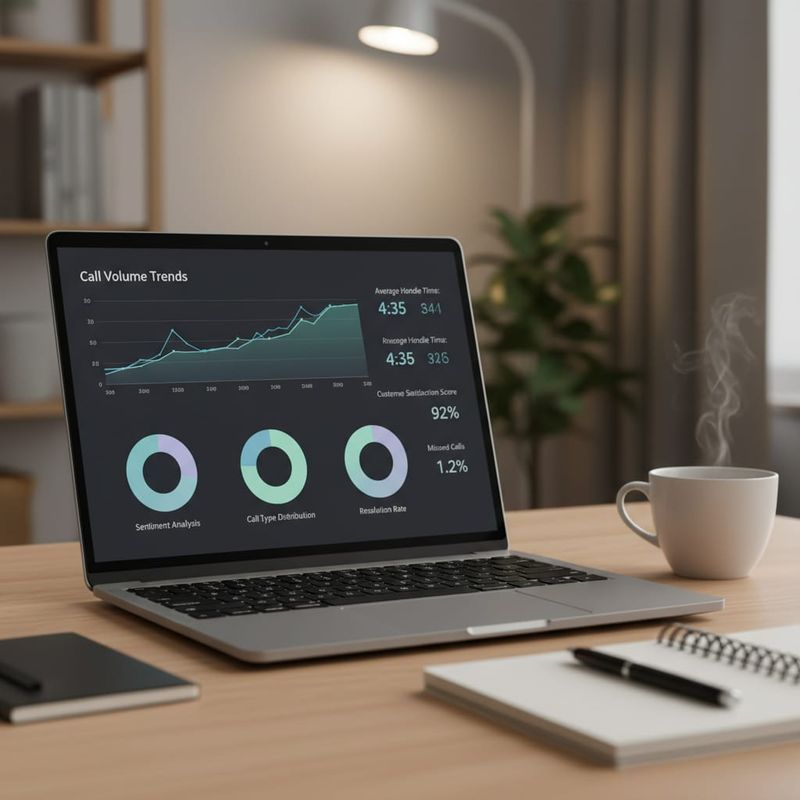
Want to see how the per-minute math works for your team's call volume? The AI calling ROI calculator takes 2 minutes and shows the break-even point versus per-seat pricing.
3. Dialpad — Best for Small Teams With AI Already Built In
Dialpad's biggest advantage over Aircall is that AI comes standard. No add-ons. The $15/user/month Essential plan (billed annually) includes real-time transcription, call summaries, and the AI Live Coach that surfaces battlecards mid-call. Aircall's equivalent feature set would cost $30 base plus $9 AI per seat. Dialpad also has no minimum user count, which makes it more accessible for teams of one or two.
- Pricing: $15/user/month (Essential), $25/user/month (Advanced) — billed annually
- AI included: real-time transcription, call summaries, AI Live Coach — all standard, all plans
- Best for: small sales or support teams that want AI assist without extra line items
- Limitation: no autonomous outbound AI agents — reps still handle every dial
4. CloudTalk — Best for Sales Teams With Deep Call Analytics
CloudTalk's Conversation Intelligence suite covers automatic transcription, sentiment tracking, topic analysis, and agent performance scoring out of the box. Their AI Dialer adjusts retry timing based on previous call outcomes — so if a number went to voicemail twice, the system waits longer before trying again. Pricing isn't published; you need a demo call to get numbers, which adds friction to the evaluation.
- AI features: AI Dialer, Conversation Intelligence, sentiment analysis, topic tracking
- Integrations: 40+ CRMs including HubSpot, Salesforce, and Pipedrive
- Best for: teams that need detailed call analytics and manager coaching dashboards
- Limitation: no public pricing — budget time for a sales process before you can evaluate cost
5. JustCall — Best for Multichannel Outreach
JustCall connects calls, SMS, email, and WhatsApp into one inbox. The AI Copilot gives reps real-time suggestions during calls and auto-fills CRM fields post-call. If your team runs outreach across multiple channels rather than just phone, JustCall consolidates that without forcing you to pay for separate tools. Pricing starts lower than Aircall's base plan.
- Channels: voice, SMS, WhatsApp, email in one inbox
- AI features: AI Copilot with real-time suggestions, automated CRM field fill
- Best for: teams doing outreach across voice, text, and messaging apps simultaneously
- Limitation: breadth across channels means less depth on any single one vs. specialists
For a deeper look at JustCall's pricing tiers and where it falls short on outbound volume, the JustCall alternatives comparison covers it in detail.
6. RingCentral — Best for Enterprise Communications
RingCentral covers phone, video, team messaging, and contact center under one contract. Enterprise IT teams tend to standardize on it because it checks every compliance box, integrates with every enterprise platform, and comes with SLAs that smaller vendors can't match. For a sales team that just needs outbound calling and AI, it's significantly more product than you need — and the pricing reflects that.
- Includes: phone, video conferencing, team messaging, contact center — full UCaaS stack
- AI features: AI Receptionist, real-time transcription, meeting summaries, coaching insights
- Best for: enterprise teams standardizing all communications under a single vendor contract
- Limitation: most sales teams use 20% of the product and pay for all of it
7. Nextiva — Best for Inbound Customer Support
Nextiva's product is built around inbound customer service. Queue management, intelligent routing, CSAT tracking, and agent performance reporting are where it's strongest. They've added outbound features and AI tools over time, but the product's DNA is support-first. If your team handles high inbound volume and reliability is the main requirement, Nextiva has a strong track record and a responsive support team.
- AI features: call summaries, chatbot routing, sentiment analysis
- Pricing: custom, requires a quote
- Best for: customer service teams managing high inbound call volume
- Limitation: outbound sales tooling feels like an afterthought compared to the core support product
8. Bland AI — Best for Developers Building Custom Call Flows
Bland AI is a developer-first platform. You define the call flow via API, connect it to your own backend logic, and Bland handles the telephony infrastructure. Pricing starts at $0.09 per minute — the cheapest option in this list if you're technical and willing to build. The tradeoff is real: there's no off-the-shelf campaign setup. Every agent is custom-coded, which means engineering time before you make your first call.
- Pricing: from $0.09/minute for basic calls
- Setup: API-first, requires developer resources to build and maintain agents
- Best for: engineering teams that want full control over conversation logic and routing
- Limitation: no pre-built campaigns — time to first call is weeks, not 15 minutes
The Bland AI vs Retell AI vs TopCalls breakdown covers per-call cost at volume and technical differences in detail.

9. Retell AI — Best for Complex Conversational AI
Retell AI focuses on conversation quality over volume throughput. The platform supports LLM-powered agents that handle branching conversations — multi-turn qualification, objection handling, appointment booking — rather than simple scripted flows. Response latency sits under 800ms, which holds up in most natural conversations. Pricing is usage-based and competitive with other AI-first platforms.
- AI model: LLM-based agents with complex branching logic and context retention
- Latency: under 800ms response time
- Best for: teams that need AI agents to navigate non-scripted, multi-turn conversations
- Limitation: more setup time than turnkey platforms; developer-friendly, not sales-team-friendly
See how Retell stacks up on pricing and features versus other AI calling platforms in the Retell vs TopCalls vs ElevenLabs breakdown.
10. The Real Cost Math: Per-Seat vs. Per-Minute
Most comparison articles stop at feature lists. The actual decision usually comes down to cost at your specific call volume, not feature checkboxes.
A 5-rep team on Aircall Professional pays $250/month in base fees, plus $45/month for the AI add-on, plus another $30+ for additional numbers. That's $325 before a single call is made. Those 5 reps can work maybe 200 to 300 calls each per month, assuming they're not doing anything else during their shift.
TopCalls at $325/month gets you roughly 928 minutes of AI calling, about 309 calls at 3 minutes each. But the AI runs 24/7, including nights and weekends. It doesn't take sick days, doesn't lose motivation after a rough afternoon, and doesn't stop to check Slack. The 309-call figure isn't a ceiling — it's what $325 buys at average call length. You can run more.
The AI cold calling ROI calculator breakdown shows the exact break-even point for different team sizes, and the SDR cost vs AI sales agent comparison digs into fully-loaded cost per qualified meeting.
11. When Aircall Still Makes Sense
Aircall is worth keeping when your primary volume is inbound and reactive outbound. A 3-person customer success team following up on inbound trials, using HubSpot, doing maybe 25 to 40 calls a day? Aircall handles that fine. The per-seat pricing is manageable, the CRM integration works well, and there's nothing to rebuild.
Where it doesn't work: proactive outbound at volume. Ten reps trying to run 80 cold calls each per day, plus follow-ups, plus demo prep — you can't fix that problem with more Aircall seats. You need AI agents to handle the dial volume so your reps focus on the conversations that actually convert.
For teams already running outbound at scale, the AI sales acceleration solution page explains how smart campaigns handle lead list management and retry logic. And if you're already running AI calling, the guide to optimizing AI cold call conversion rates covers how to squeeze more meetings out of the same call volume.
The per-seat model made sense when calling software was just a phone in a browser. It doesn't reflect what's possible when the calling is done by an AI that runs continuously and books directly into your calendar.
If you're looking at alternatives because Aircall's cost is getting hard to justify — or because your reps physically can't call at the volume your pipeline needs — book a strategy call or start with the ROI calculator. Neither requires a credit card.
Frequently Asked Questions
Get AI calling tips in your inbox
No spam. One email per week with actionable sales automation tips.