Ten thousand AI calls, zero consent forms. That's how fast a sales team can rack up $15 million in TCPA liability. The Federal Communications Commission confirmed in February 2024 that AI-generated voice calls fall under the Telephone Consumer Protection Act, and the fines don't scale nicely. Each call is $500. Each willful violation is $1,500. Class actions don't cap at a few plaintiffs.
TCPA compliance for AI cold calling isn't a legal department problem anymore. It's a sales ops problem. Your dialer, your consent collection process, and even the words your AI agent says at the start of a call can expose your company to seven-figure lawsuits.
This guide covers what changed, what your team needs to do differently, and how to run compliant AI cold calling at scale without slowing down your outbound volume.
Key Takeaways
- The FCC confirmed in February 2024 that AI-generated voice calls fall under TCPA, ending any gray-zone argument for AI calling.
- Penalties run $500 per standard call and $1,500 per willful violation, so a 10,000-call campaign without consent risks up to $15 million.
- Marketing AI calls require prior express written consent that explicitly names AI-generated voice technology before the first dial.
- As of April 11, 2025, opt-out requests must be honored within 10 business days and apply across voice, text, and email at once.
- TopCalls detects opt-out language in real time and stores timestamped compliance records automatically, with exportable reports on demand.
1. What the FCC's 2024 Ruling Actually Changed for AI Calling
Before February 2024, there was a plausible argument that AI voice agents weren't "artificial or prerecorded" voices under TCPA. Some companies ran AI calling campaigns assuming the rules were ambiguous. The FCC closed that door. AI-generated voices are now explicitly covered, subject to the same rules that apply to robocalls.
The ruling stemmed from a complaint about political robocalls using synthetic voices. The FCC wrote it broadly. Any call using AI to generate or modify the voice counts. That includes every major AI cold calling platform on the market today, including TopCalls, Bland AI, Vapi, Retell, and others.

What didn't change: the underlying consent requirements. Those existed before. What changed: you can't assume AI calling is in a gray zone. Enforcement is active. Plaintiffs know this, and class action lawsuits are already being filed against companies running unconsented AI calling campaigns.
2. Two Types of TCPA Consent (and Which One AI Calling Requires)
TCPA recognizes two consent levels, and which one you need depends on what your AI is calling about. Get this wrong and your consent forms are worthless.
Prior Express Consent: Required for informational calls. This applies when you're calling to provide a service update, delivery notification, or appointment reminder. The person gave you their phone number and can reasonably expect to receive calls about that service. Written consent isn't required, but you still need documented evidence they agreed.
Prior Express Written Consent: Required for marketing and promotional calls. This means a signed agreement (digital signatures count) where the person explicitly agrees to receive marketing calls using autodialed or AI-generated voice technology. The consent language must clearly disclose what they're agreeing to. Buried checkbox language doesn't hold up in court.
For most sales teams, the relevant standard is express written consent. If your AI agent is calling prospects to pitch a product or set appointments, that's marketing. You need written consent before the first call. Buying a lead list and dialing it with an AI agent, without documented consent specifically mentioning AI contact, puts you at $1,500 per call.
3. The New Opt-Out Rules That Took Effect April 2025
As of April 11, 2025, companies must honor opt-out requests within 10 business days. That's down from 30. But the bigger change is how broadly opt-out language is now interpreted.
A prospect saying "stop calling me," "take me off your list," "don't contact me again," or even just "opt out" during a call must trigger immediate suppression. The rules apply across all channels, too. An opt-out via text message must stop AI voice calls. An opt-out during a voice call must stop email follow-ups. One request covers all channels simultaneously.
For AI calling platforms, this means the AI itself needs to detect opt-out language in real time and trigger suppression automatically, not log it for someone to process later. Platforms that can't do this create a compliance window between the call and the suppression. If you're running high-volume campaigns, that window is expensive. See also: managing outbound call quality at scale.
Want to see what non-compliant calling could cost vs. what compliant AI calling earns? Run the numbers in our outbound ROI calculator to model both scenarios.
4. Disclosure Requirements for AI-Generated Calls
The FCC has moved toward requiring AI callers to identify themselves as AI at the start of a call. While exact wording requirements are still being finalized, the direction is clear: "this call is being made using an AI-generated voice" or equivalent language needs to appear early, not buried after a two-minute pitch.
Practically, this means building the disclosure into your AI agent's opening script. Something like: "Hi, this is an AI calling on behalf of [Company]. You can say 'stop' at any time to be removed from our list." That covers both the AI disclosure and the opt-out notice in one opening line. See how different AI call scripts handle compliance disclosures for different call types.
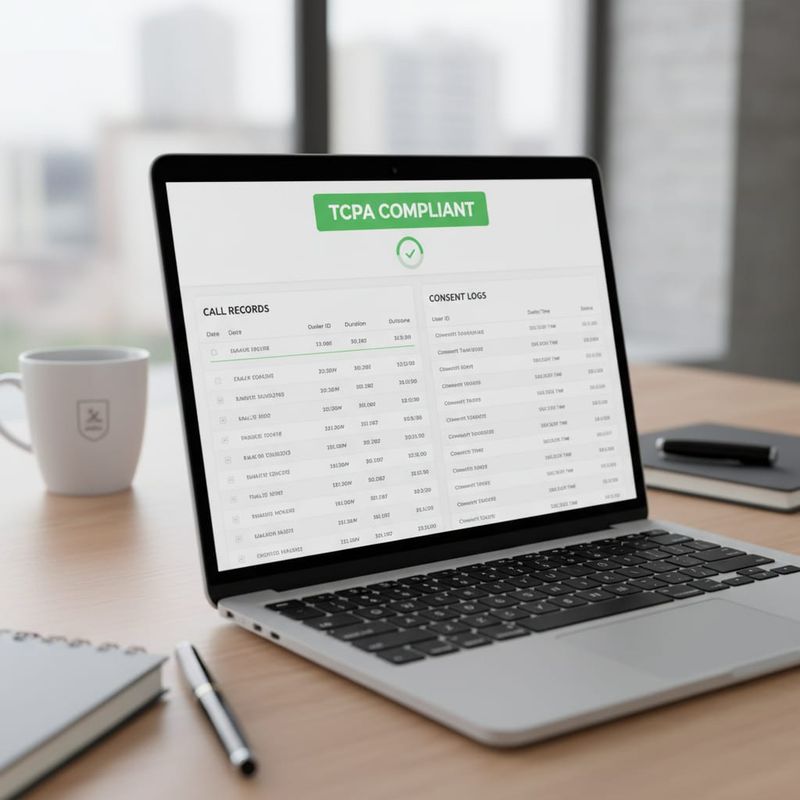
Logging is the other half of disclosure compliance. Every call needs a timestamped record: who was called, what consent was on file, whether the person opted out, and what the AI said. If you're ever sued, this log is your defense. TopCalls stores these records automatically as part of our TCPA-compliant calling infrastructure, with exportable compliance reports on demand.
5. What TCPA-Compliant AI Calling Looks Like in Practice
A compliant AI calling workflow isn't that different from a compliant human calling workflow. The main differences are how you collect consent at scale and how you handle opt-outs automatically. Here's what it looks like when AI voice agents are configured correctly:
Consent at the source: Lead capture forms include explicit AI calling consent language. "By submitting this form, you agree to receive automated calls using AI-generated voices from [Company]." Unchecked checkbox, logged with timestamp and IP address.
Scrubbed against DNC lists: Every campaign run checks numbers against the National Do Not Call Registry before dialing. Calling a DNC number with an AI agent that lacks documented consent is a guaranteed $1,500-per-call violation.
Real-time opt-out detection: The AI recognizes opt-out language mid-call and ends the conversation immediately, logging the suppression. That lead is blocked from all future campaigns automatically, within seconds.
With those three pieces in place, teams run AI appointment setting at scale without legal exposure. The compliance infrastructure runs in the background. Your team just sees the booked meetings.
6. When AI Cold Calling Is Fine (and When It Creates Real Legal Risk)
Not every AI calling use case carries the same risk level. The call type and your consent documentation determine where you stand.
Lower risk: Calling existing customers who provided their number at signup, with the AI agent used for appointment reminders or service updates. You likely have express consent, the call is informational, and documenting it is straightforward.

Higher risk: Cold-calling purchased lead lists with an AI voice agent, with no documented consent for AI contact. Even if a prospect filled out a form on a lead gen site, that consent may not cover your specific use of AI calling. This is where most TCPA lawsuits start. For context on what compliant campaigns actually produce, see our guide to AI cold calling metrics and benchmarks.
7. TCPA Compliance Checklist for Sales Teams Using AI Calling
Run through these before you launch any AI calling campaign:
Consent documentation: Every number in your campaign list needs a timestamped consent record that explicitly covers AI-generated voice calls. "Consent to be contacted" without mentioning AI won't hold up in court.
DNC scrub: Check your list against the National DNC Registry within 31 days before calling. For state-level compliance, check California, Texas, and Florida DNC lists separately. They each have additional requirements on top of federal TCPA.
AI disclosure in opening script: The AI identifies itself in the first 10 seconds. Pair it with a verbal opt-out instruction: "You can say 'stop' at any time to be removed from our list."
Automated opt-out suppression: Your AI platform must detect opt-out language and block the number across all channels immediately, not just the call queue. If your platform can't do this automatically, that's a compliance gap you need to close before your next campaign.
Call records and logs: Keep timestamped records of every call: who was dialed, what consent was documented, what the outcome was, any opt-outs logged. Retain these for a minimum of 4 years (the TCPA statute of limitations).
Teams doing this right are running more AI calls than before, not fewer. They picked AI cold calling software built with compliance infrastructure built in, set up consent collection properly at the lead capture stage, and let the AI sales motion run without interruption. Compliance isn't a slowdown. It's how you protect the volume.
If you want to review your specific calling setup and whether your consent flow covers you for AI calling, book a strategy call with our team. We'll go through your workflow and flag the gaps.
Frequently Asked Questions
Get AI calling tips in your inbox
No spam. One email per week with actionable sales automation tips.