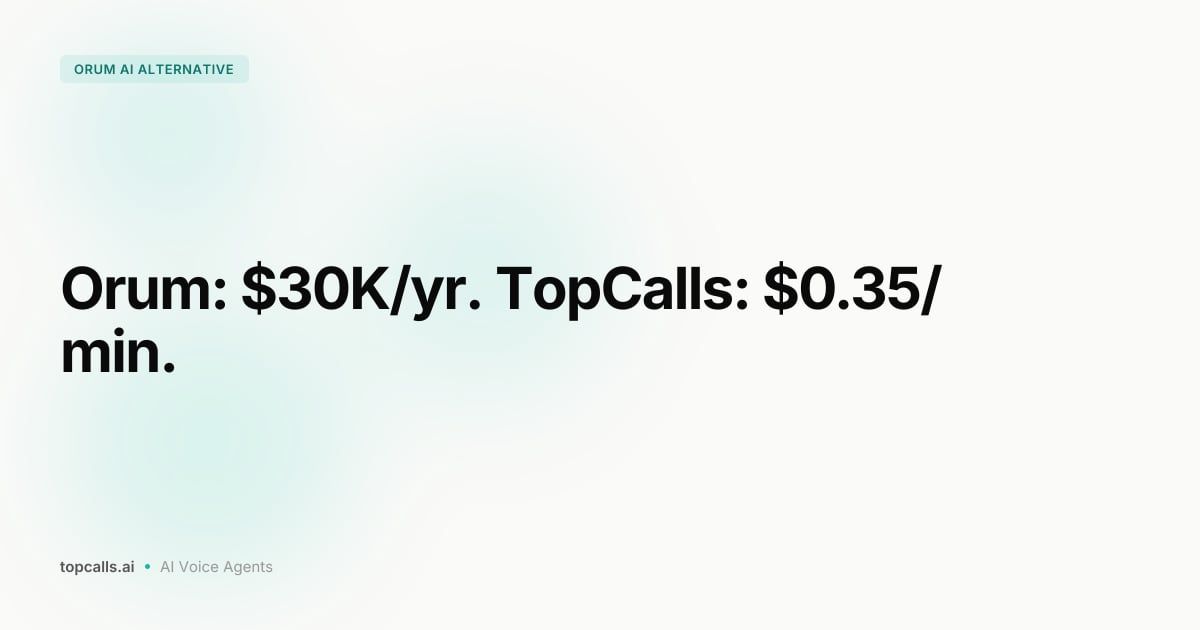
Orum AI starts at $250 per seat per month. With a 3-seat minimum and annual-only contracts, a 5-person SDR team is committing $15,000 in software before their first call goes out. TopCalls charges $0.35 per minute, everything included. The pricing model is different enough that comparing them on a feature checklist misses the point.
Orum makes human reps faster. TopCalls handles the calls itself. Both can produce booked meetings. But the cost structure, who does the talking, and what happens at scale look completely different.
1. What Orum AI Actually Does
Orum is a parallel dialer. A rep loads a lead list, Orum fires 7 to 10 dials at once, and when a human answers, AI skips the voicemail in under half a second and connects the rep directly. It's genuinely fast. Their Hot Numbers feature reportedly hits 22% connect rates against a 5% industry average, and the platform has powered 1 billion+ calls.
For SDR teams making 80+ calls a day, the productivity math holds up. If each rep handles 3x more live conversations per hour, you need fewer reps to hit the same pipeline targets. That's the core pitch.
But Orum multiplies human salespeople. It doesn't replace them. The software adds $250/month per rep on top of salaries that already run $50k to $70k a year.
2. Three Things Orum Users Keep Flagging
Before committing to that annual contract, here's what comes up most in G2 reviews and sales forums:
Connection delay: Parallel dialing has a structural problem. When a prospect answers, there's a 1 to 2 second pause before the rep's voice comes through. That silence reads as a robocall. G2 has 101 separate reviews flagging this. It's not a bug Orum can fix easily. It's built into how parallel dialing works.
Annual contract lock-in: Orum doesn't offer monthly billing. 3-seat minimum, annual commitments only. A 5-person team is locked into $15,000 before knowing if the platform fits their workflow. For teams that want to pilot before committing, that's a hard ask.
No multi-channel: Orum dials calls, nothing else. No email sequencing, no SMS, no inbound routing. Running a complete outbound motion means stacking it with an email tool, a sequencing platform, and a separate CRM integration layer.

If any of those three points match your current pain with Orum, that's where alternatives start to make real sense.
3. How TopCalls Approaches Outbound
TopCalls doesn't speed up your reps. It runs AI voice agents that handle calls autonomously, end-to-end. The AI dials, qualifies the lead through a conversation you define, books directly into the rep's calendar, and logs everything to your CRM. No human in the loop until the meeting is booked.
Response latency sits under 500 milliseconds, built on the OpenAI Realtime API. That's fast enough that conversations feel natural. No connection pause, because there's no human rep being connected. The AI handles qualifying, objection handling, and direct calendar booking in one call.
It runs 24/7. 29 languages, 36 regional accent variants. A campaign targeting Spanish-speaking LatAm markets runs the same day as a North American English campaign, with no separate dialer setup required.
4. Cost-Per-Meeting: Running the Numbers
Here's a straight comparison for a 5-person outbound team:
Orum (5 human SDRs):
- 5 seats × $250/month = $1,250/month in software ($15,000/year)
- 5 SDR salaries at $55k average = $275,000/year
- Fully loaded cost: ~$290,000/year
TopCalls AI agents (equivalent outbound volume):
- 10,000 AI calls/month at 2 minutes average = 20,000 minutes
- 20,000 × $0.35 = $7,000/month ($84,000/year)
- SDR salaries: $0
That's roughly $206,000/year less, before counting management time and rep onboarding. Want to run the numbers with your actual call volume and booking rates? Use our AI cold calling ROI calculator to build the comparison for your team.

For a deeper breakdown that includes salary, benefits, and ramp time, our piece on SDR cost vs. AI sales agent economics covers the full math.
5. Feature-by-Feature Breakdown
Here's how the two platforms compare on the things that actually affect your outbound results:
Pricing model: Orum charges $250/user/month, annual contracts only, 3-seat minimum ($9,000/year minimum). TopCalls charges $0.35/minute all-inclusive, SIP trunking and AI processing both included, no seat floor, no contract.
Who talks: With Orum, your human rep takes every live call after the AI connects them. With TopCalls, the AI voice agent handles the full conversation, from intro through qualification, objections, and booking.
Connection experience: Orum's parallel architecture introduces a 1 to 2 second delay when a prospect answers. TopCalls responds in under 500ms, so the conversation starts immediately and doesn't trigger the 'robocall' instinct.
Language support: Orum is English-first. TopCalls runs in 29 languages with 36 regional accent variants, all at the same sub-500ms response speed, with automatic language detection mid-call.
CRM and integrations: Orum integrates with Salesforce, HubSpot, and Salesloft. TopCalls connects to the same CRMs plus Pipedrive, Close, Google Calendar, Calendly, and 5,000+ apps via Zapier.
Setup time: Orum typically takes 1 to 3 weeks to implement. TopCalls standard deployments go live in 15 minutes, with full campaigns running in 2 weeks through the included onboarding team.

Contract: Orum requires annual commitment, no month-to-month option. TopCalls has no contract, a 14-day free trial with no credit card required, and you cancel any time.
6. When Orum Still Makes Sense
Orum works best when your SDR team is large and your sales motion depends on human reps doing the actual selling, not just qualifying leads.
If you've got 20+ reps with a proven ICP and you need more live conversations per rep per day without changing the process, parallel dialing has a real ROI case. Your reps are already on payroll. Adding $250/month per person to triple their call volume is defensible.
It's also better suited for high-ACV deals where reps need to read the room, pivot mid-call, or build rapport before the first meeting. Complex multi-stakeholder enterprise sales with $100k+ contract values aren't a great fit for fully automated calls yet.
7. When TopCalls Wins
TopCalls is the better move when the early-funnel work can run on AI without losing conversion quality. Specifically:
- Your lead list is broad and needs qualification before human reps get involved
- You need 24/7 coverage across time zones without building a shift schedule
- You're targeting multiple languages or international markets
- You're paying per-seat software costs on top of SDR salaries and want to consolidate
- You want AI to handle the 80% of calls that end in voicemail or 'not interested' before a real conversation starts
The goal isn't to replace great salespeople. It's to stop paying them to dial numbers that go straight to voicemail. TopCalls' AI voice agents take the repetitive early-funnel load so your reps spend their time on warm conversations. For teams focused on pipeline velocity, our sales acceleration use cases show how this plays out in practice.
8. Where TopCalls Doesn't Work
If you're selling $100k+ enterprise contracts where the first call needs to be a VP-level strategic conversation, AI cold outreach won't get you there. Buyers at that level expect a named human contact from the first touchpoint.
And if your reps are already getting strong connect rates and conversion quality is the bottleneck, Orum might close that gap faster. Not every outbound problem is a volume problem.
Both platforms work. Orum accelerates the human. TopCalls removes the human from the equation for early-funnel work. Which one wins depends on whether you're optimizing your SDRs or replacing what they do before the first real conversation.
If you're spending $250+ per seat per month on top of SDR salaries, it's worth running the numbers. Book a strategy call to walk through whether your use case fits, or check the SDR cost vs. AI agent breakdown to build the comparison yourself.
Get AI calling tips in your inbox
No spam. One email per week with actionable sales automation tips.